Intention
What is the person trying to achieve, protect, avoid or preserve—and which habitual cognitive routes are shaping that intention?
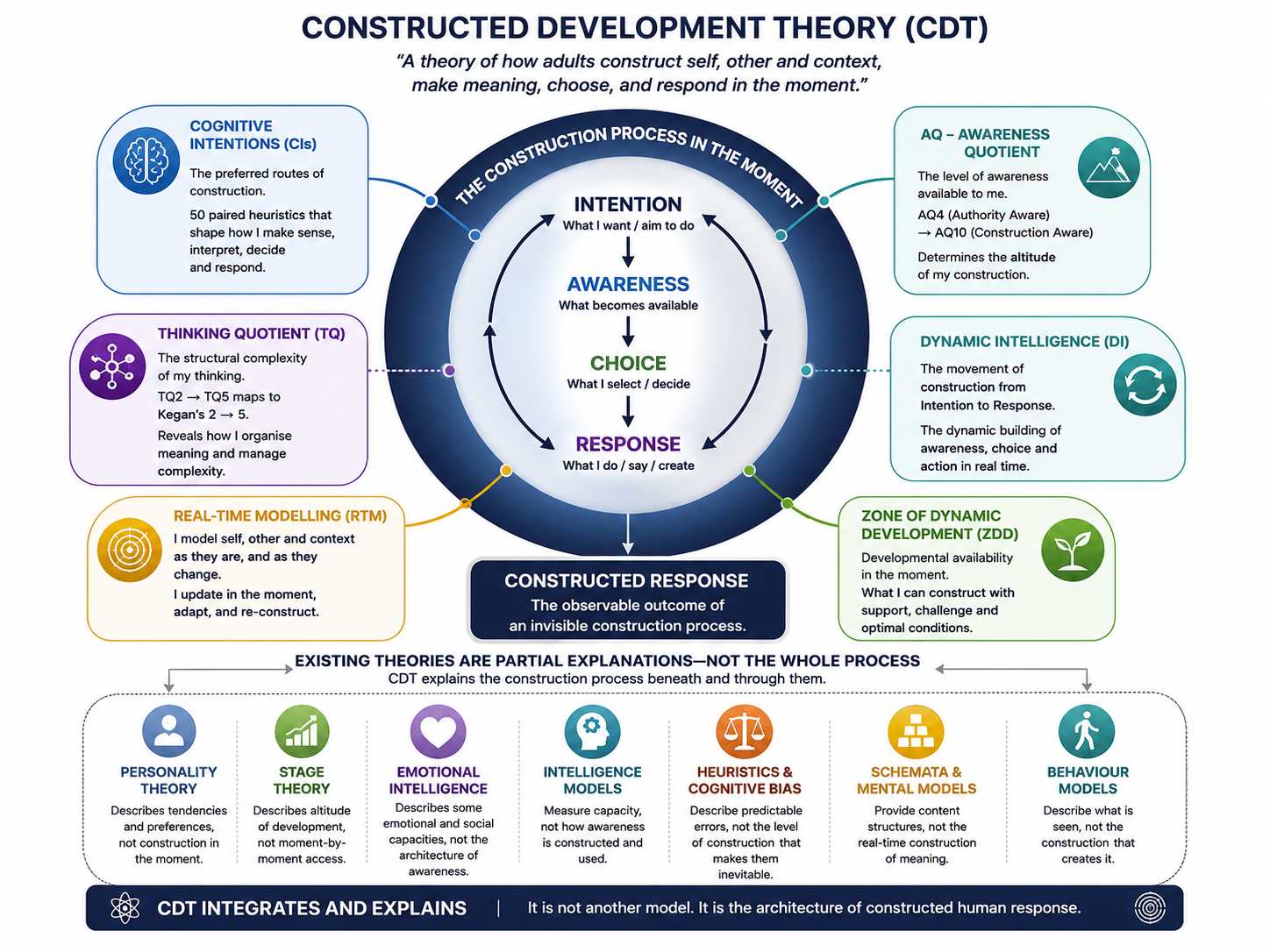
Constructed Development Theory explains how a person constructs self, other people, context, meaning, choice and response in real time—and how awareness changes what becomes available to construct.
Constructed Development Theory is the study of how aware we are of constructing self, context and environment in the moment—and how effectively we construct them.
Two people can enter the same meeting. One constructs challenge and becomes curious; another constructs threat and becomes defensive. The event is shared. The available awareness, meaning, choice and response are not.
IACR describes the recursive movement from what a person is trying to achieve, protect or avoid to the response that becomes visible. Dynamic Intelligence is the capacity to navigate that construction deliberately in the moment.
What is the person trying to achieve, protect, avoid or preserve—and which habitual cognitive routes are shaping that intention?
How much of that construction can the person currently notice, including their thinking, emotion, assumptions and effect on others?
Which alternatives are genuinely available once the person can see the construction and its relationship with the present context?
What is enacted after intention has moved through the awareness and choice available in that moment?
Dynamic Intelligence is not simply cognitive balance. It is the live capacity to construct self-awareness, interrupt habituated movement and navigate from intention to an effective response. Each response also changes the next context, so the sequence is recursive rather than a one-way pipeline.
CDT moves from the smallest habitual routes of attention to the wider architecture of awareness, complexity and response.
Fifty cognitive heuristics that influence where attention goes and how experience is constructed. Developed from Meta-Programmes, they are reframed in CDT around intention, polarity, context and awareness.
The context-sensitive combination of Cognitive Intentions a person uses repeatedly. It describes a preferred route of construction—not a fixed personality identity.
The capacity to recognise and navigate construction from intention, through awareness and choice, into a response that better fits the moment.
A structured account of Dynamic Awareness: what a person can notice about the construction of self, other and context, and the capacities associated with that awareness.
A rule-based, context-sensitive way of relating combinations of Cognitive Intentions to cognitive and social-emotional complexity.
A way to examine the awareness and construction becoming available to an adult—often with the support of a More Complex Other—rather than treating development as knowledge supplied from outside.
Neither is intended to become a permanent label. They organise observations about awareness and complexity while retaining CDT’s emphasis on context, movement and development.
AQ describes shifts in the awareness from which a person can construct self, other people, context and response. Greater AQ implies a wider capacity to notice the construction itself, hold self and other in view, and make choice more deliberate.
AQ concerns the availability and quality of awareness—not how informed, articulate or conventionally intelligent someone appears.
TQ maps combinations and polarities of Cognitive Intentions to cognitive and social-emotional complexity, drawing on adult-development work associated with Robert Kegan and Otto Laske.
TQ is conceived as rule-based and context-sensitive. Its purpose is to make patterns of complexity examinable, not to turn a developmental estimate into identity.
CDT does not discard stage development. It changes the emphasis from locating the person abstractly to examining what awareness, complexity and response are available in a particular context.
Where is this person developmentally?
This can describe a broad developmental altitude or structural tendency, but it may not reveal what is accessible under the conditions of the live moment.
What could this person notice, choose and construct here?
This examines awareness, complexity and response as context-sensitive availability rather than as a fixed possession.
Development adds range; it does not delete earlier constructions. A person may have access to more complex awareness and still reproduce a familiar pattern under pressure, in a particular role or within a specific relationship.
The developmental question therefore becomes practical: what supports the person to take a former subject of experience as an object they can notice, examine and choose around?
CDT emerged from research rather than beginning as a commercial typology.
The research initially examined how postgraduate students constructed thinking and behaviour through metacognition, constructivism and adult-stage development, using Identity Compass profiles as an early source of structured data.
The work reframed habitual cognitive patterns as Cognitive Intentions and investigated how different combinations contributed to distinctive, context-sensitive Thinking Styles.
The research question evolved from mapping patterns of thought towards whether Dynamic Intelligence could provide a conceptual account of self-awareness in the moment.
TQ developed as a way to normalise profile outputs and relate CI combinations to developmental complexity, with Kegan’s and Laske’s frameworks providing important benchmarks and points of comparison.
The studies indicated that participants’ in-the-moment awareness could be lower than their self-estimate and that Thinking Style and awareness varied across contexts—supporting a theory built around live construction rather than static trait possession.
Some constructs describe the core theory; others translate its logic into observation, practice, organisational work or later philosophical exploration.
Related lenses on live navigation, available awareness and structural complexity.
An adult-developmental account of the construction becoming available, including the developmental value of a More Complex Other.
Models for organising visible response, deeper construction and layers of developmental awareness.
A practice for making a person’s construction visible as it occurs, rather than relying only on retrospective explanation.
Ways of translating CDT into cognitive and emotional reconstruction, leadership, teams and organisational development.
A later philosophical extension exploring the relationship between being, thinking, awareness and deliberate construction.
Because CDT examines the construction beneath response, it can travel across domains without becoming a substitute for the specialist knowledge, ethics or professional competence each domain requires.
Reveal the construction beneath goals, limitations and repeated patterns; develop awareness and expand the responses available.
Develop decision quality, self/other-awareness and the capacity to respond without defensive simplification under complexity.
Move beyond content acquisition towards metacognition, self-authorship and the developmental conditions for learning.
Examine how leaders and systems construct culture, authority, problems, fragmentation and the action they consider possible.
Support cognitive and emotional reconstruction within the practitioner’s training, professional scope and safeguarding obligations.
Notice familiar constructions, loosen their claim to be identity, and practise more deliberate choice in everyday life.
CDT is a developmental framework, not a clinical diagnosis. Application in therapy, mental health, policing, prisons, education or other regulated and high-stakes settings requires appropriate expertise, evidence, governance and ethical oversight.
The purpose of CDT is to make construction more visible, not to reduce a person to a category.
A Thinking Style is a repeated and context-sensitive construction, not an identity. CDT therefore differs from fixed-type readings of MBTI, Enneagram or DISC.
Development concerns what awareness and complexity are available in context, not only an abstract or permanent location.
Behaviour is treated as the visible residue of intention, awareness, meaning and available choice.
CDT develops observation, judgement and developmental practice. It does not prescribe one technique for every person or context.
These pages serve different purposes: original research, concise orientation, practical application and the developing archive of CDT ideas.
CDT offers a language for examining the thinking beneath personality, behaviour and response. The theory’s continuing task is to refine that language, test its claims and develop practices that help people meet complexity with more awareness and range.