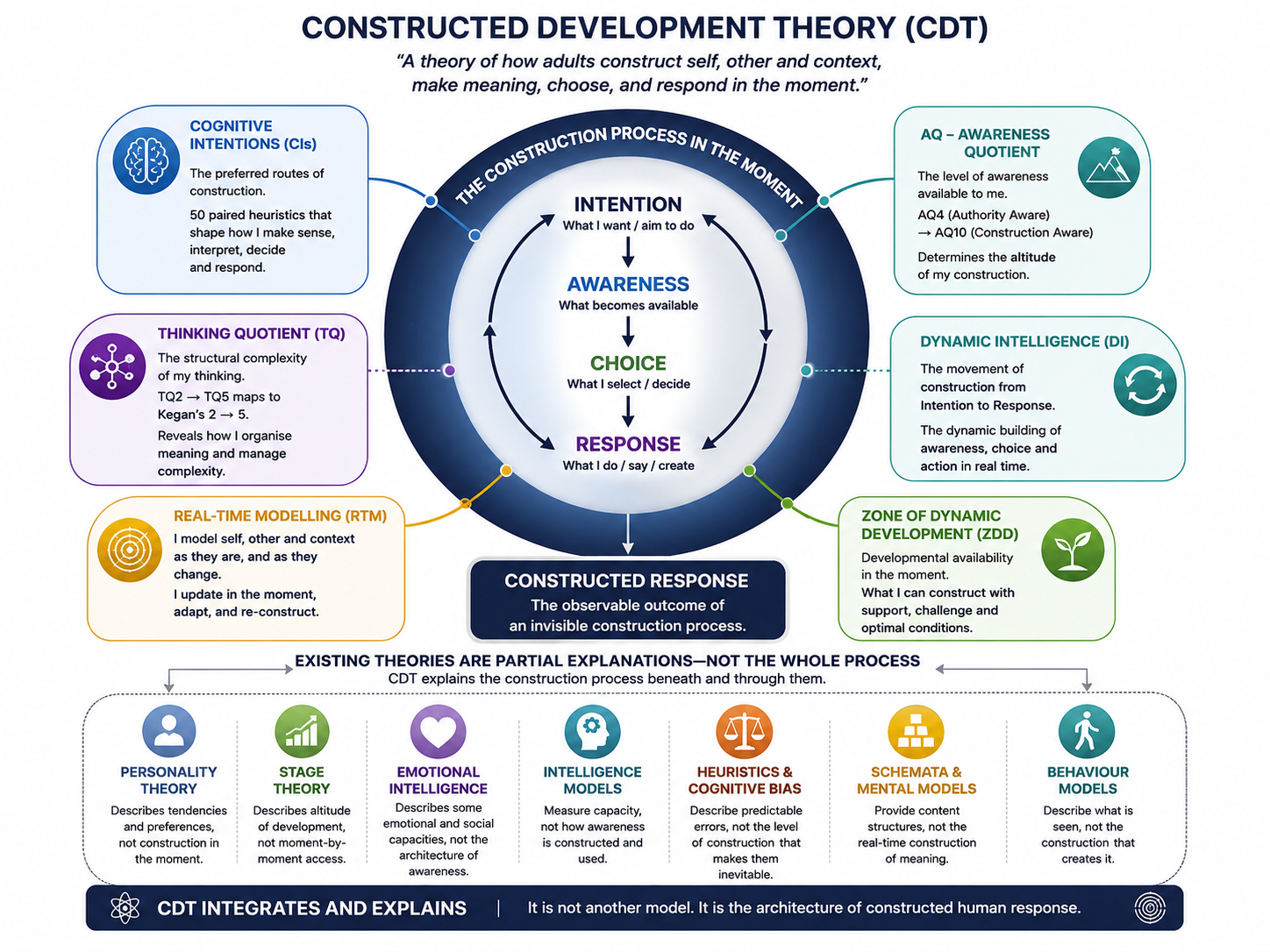
Constructed Development Theory (CDT) is the study of how aware we are of constructing self, context, and environment in the moment, and how effectively we construct them.
Developed by Dr Darren Stevens, CDT explores how individuals construct their thinking in real time. Unlike traditional personality models that categorise people into fixed types, CDT emphasises the dynamic nature of cognition and self-awareness. It offers a fluid, developmental approach to understanding human thought processes.
CDT reframes personality as dynamic, self-awareness as measurable, and development as deliberate self-construction in real time.
Introduction to CDT
CDT is founded on the premise that cognition is not static but constructed in real time through habitual thinking patterns called Cognitive Intentions. The degree of self-awareness individuals have in constructing their thoughts determines their Awareness Quotient and Dynamic Intelligence, which directly influence their ability to adapt, learn, and navigate complex situations.
Core Principles of CDT
CDT positions development as fluid, holarchical, and context-dependent. Rather than assuming that people move through fixed stages in a simple linear progression, CDT focuses on how people construct self, context, and environment in the moment.
Constructed Development Theory is the study of how aware we are of constructing self, context, and environment in the moment, and how effectively we construct them. It measures both Dynamic Intelligence — the process of constructing thought — and Awareness Quotient — the predictable behavioural outcomes of that construction.
Key Components of CDT
1. Dynamic Intelligence
Dynamic Intelligence is the ability to construct self-awareness in the moment in order to navigate from Intention to Response effectively. The more Dynamic Intelligence an individual has, the more adaptable and self-aware their decision-making becomes.
Dynamic Intelligence is expressed through four recursive pillars:
- Intention: Why am I thinking this way?
- Awareness: Do I know I am thinking this way?
- Choice: Can I think differently in this moment?
- Response: What action do I take?
Dynamic Intelligence is not simply balance. It is deliberate navigation of thought, enabling conscious intervention in habituated patterns.
2. Awareness Quotient
Awareness Quotient measures an individual's level of Dynamic Awareness: how consciously they construct their reality in response to context. Higher AQ levels indicate greater cognitive complexity, emotional resilience, and self/other-awareness.
CDT begins measurement at AQ4, with levels AQ4–AQ10 defining predictable shifts in cognitive complexity, emotional resilience, and self/other-awareness. AQ emerges from repeated exposure to unconscious heuristics through Cognitive Intention use, extending Dynamic Intelligence into long-term developmental growth.
3. The Four Pillars of CDT
CDT operates through four key pillars:
- Intention: the thought process before an action is taken.
- Awareness: the level of conscious recognition of one’s thought construction.
- Choice: the ability to select a response rather than react automatically.
- Response: the action taken based on the previous three pillars.
These pillars guide an individual’s thinking, shaping decision-making and behavioural outcomes.
4. Cognitive Intentions
CDT identifies 50 Cognitive Intentions. These are habitual thinking patterns that shape an individual’s perception of the world. They were originally derived from Meta-Programmes but are redefined in CDT as heuristics with intention and awareness embedded.
Each Cognitive Intention carries polarity and potential for disequilibrium. CIs combine into Thinking Styles: unique cognitive signatures that shape how individuals navigate the Four Pillars. Awareness of CIs unlocks flexibility and allows intentional self-reconstruction in the moment.
5. Thinking Style
A Thinking Style is the unique combination of Cognitive Intentions an individual uses regularly. It defines how a person perceives, processes, and responds to information. Increasing self-awareness of one's Thinking Style allows for greater adaptability and intentional thinking.
Measuring Development in CDT
CDT provides structured tools for measuring cognitive complexity and development.
Thinking Quotient
Thinking Quotient measures cognitive and social-emotional complexity by mapping Cognitive Intention combinations to Robert Kegan’s framework of adult development. Higher TQ indicates greater awareness of CI polarity and greater capacity for flexibility. TQ is rule-based, dynamic, and context-sensitive, reflecting cognitive disequilibrium rather than fixed progression.
Awareness Quotient
Awareness Quotient tracks an individual’s self-awareness in constructing thought, ranging from lower AQ levels associated with habitual, unconscious thinking to higher AQ levels associated with deliberate, self-constructed thought.
Moving Beyond Stage Models
CDT challenges the assumption of linear stage-based development. Development is not progression through stages but expansion of available constructions in the moment. Growth is holarchical: layers of self-awareness and choice are added without erasing earlier patterns. This allows context-specific, recursive adaptation rather than rigid progression.
Personality is not who you are. It is a repeated construction that has become familiar enough to feel like identity.
Applications of CDT
CDT is highly versatile and can be applied across multiple domains:
- Personal development: enhancing self-awareness, decision-making, and adaptability.
- Leadership and coaching: developing leaders with high Dynamic Intelligence who can navigate complexity.
- Therapy: CAIR as an approach to cognitive and emotional reconstruction.
- Organisational change: supporting businesses in understanding how individuals at different cognitive levels respond to change.
- Education and learning: moving beyond fixed personality models to empower individuals in cognitive growth.
- Politics and society: measuring developmental readiness to govern.
Contributions of CDT
CDT introduces several original contributions to psychology and adult learning:
- Dynamic Intelligence and Awareness Quotient as measurable constructs.
- Thinking Quotient as a rule-based developmental metric.
- Zone of Dynamic Development.
- Constructed Development Onion and Iceberg models.
- Real-Time Modelling.
- CAIR for therapy and FRAME for business applications.
- Anesis and Anatman as philosophical extensions.
- Reframing Emotional Intelligence as a subset of Dynamic Intelligence.
How CDT Differs from Other Models
Unlike typology-based personality models such as MBTI, Enneagram, and DISC, which categorise individuals into static profiles, CDT recognises cognition as fluid and constructible. It offers a developmental pathway rather than a fixed label, aligning adult development, cognitive complexity, metacognition, and practical application.
Next Steps
For those interested in applying CDT in their personal or professional lives, the next steps are to explore CDT workshops, assess Awareness Quotient and Dynamic Intelligence through structured self-awareness exercises, and engage in Next Level Coaching as a CDT-based approach to personal and professional growth.
This page acts as a short orientation to Constructed Development Theory within the Blogging Deliberately archive. It is the doorway into the wider CDT essays, tools, applications, and philosophical extensions.