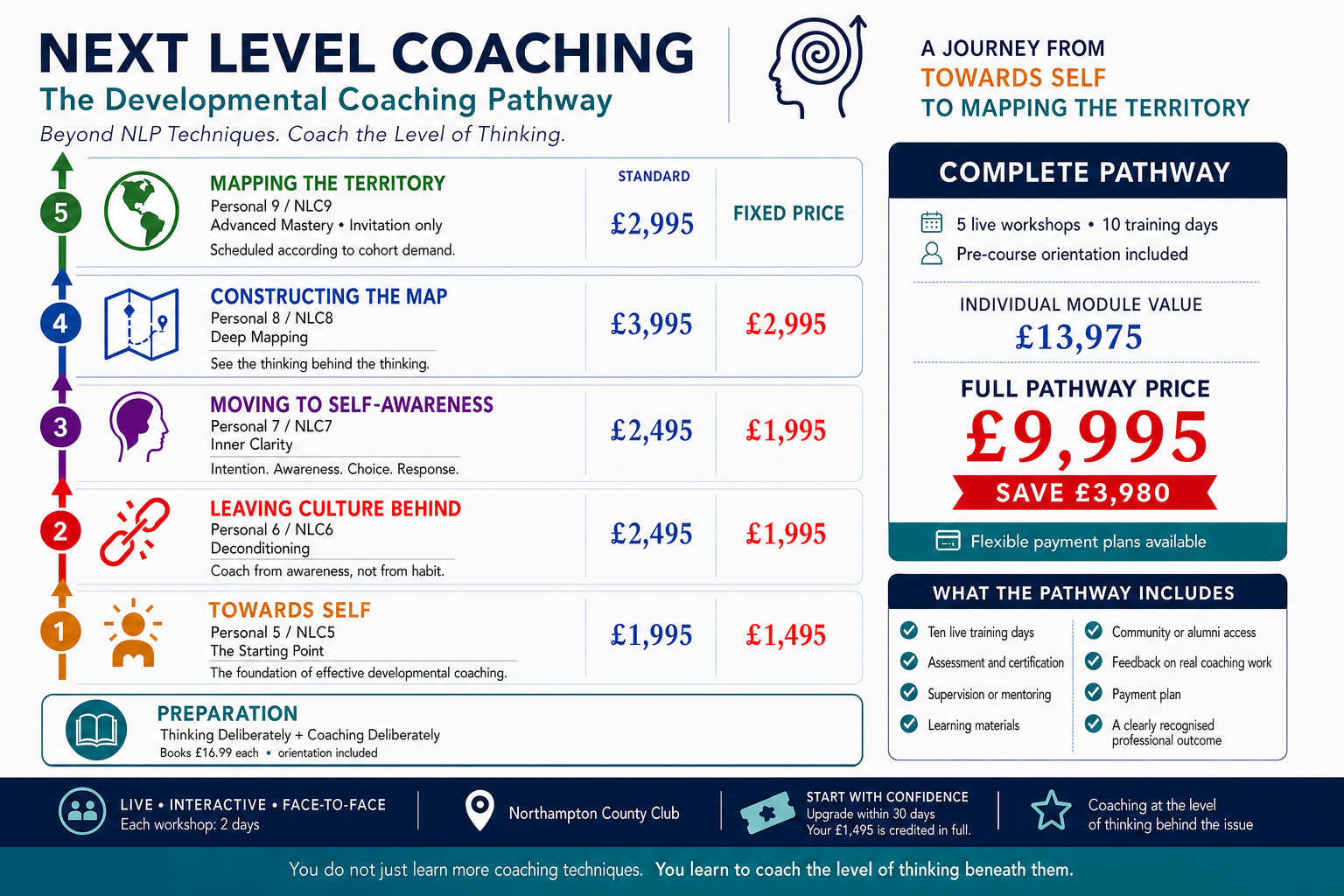
Certified Constructed Development Practitioner
A proposed designation for practitioners assessed as able to apply CDT safely within their existing professional domain.
A professional development route for coaches, educators, consultants, leaders, and psychologists who want to work with adult development as it is constructed in real time.
Most professional development remains horizontal. It improves skills, behaviours, models, and techniques, but often leaves the person’s construction of reality untouched.
Constructed Development Theory gives practitioners a way to work vertically: with awareness, intention, choice, response, cognitive intentions, adaptive intelligence, and the developmental construction of self and context.
This pathway is for people who want to practise CDT with rigour, ethics, supervision, and a clear scope of practice.
Core training in CDT, the IACR model, Dynamic Intelligence, Awareness Quotient, Thinking Quotient, Cognitive Intentions, and the difference between personality, behaviour, and construction.
Supervised application in coaching, leadership, education, organisational development, communication, or adult learning contexts.
Evidence of applied competence through case studies, observed practice, reflective analysis, and the ability to distinguish CDT practice from therapy, diagnosis, or protected psychological work.
The proposed model requires practitioners to maintain ethical standards, undertake continuing professional development, engage in supervision, and renew certification periodically.
A proposed designation for practitioners assessed as able to apply CDT safely within their existing professional domain.
A proposed advanced designation for practitioners assessed in more complex developmental work, supervision, and systems application.
Any future specialist endorsement will require clear eligibility, scope-of-practice rules, public representation standards, and appropriate professional review.
The credibility of any designation depends on the standards behind it. The proposed certification model is therefore being built around competence, ethical practice, supervised application, and clarity of public representation.
This pathway is suitable for coaches, consultants, educators, trainers, leadership developers, organisational development practitioners, therapists working within their existing competence, and psychologists who want to add a CDT lens to their work.
It is especially relevant for practitioners who want to move beyond typology, traits, diagnostic labels, motivational slogans, and behavioural technique — and work instead with the construction of awareness itself.
The Institute for Adult Development is developing a professional certification pathway in Constructed Development Theory. Early applicants will be invited to discuss their background, current practice, and intended use of CDT.